The Pattern
Self-hypnosis is not stage magic and it is not sleep. It is closer to the state you fall into when a book absorbs you so completely that someone has to say your name twice. You stay awake. You stay in control. The worst thing that can happen is you drift off and take a nap.
What hypnosis adds is that a suggestion (one short sentence you repeat to yourself in that state) lands harder once you are absorbed. The part of your mind that argues with everything gets quieter, and a picture you deliberately build starts steering the feeling instead of just describing it.
A 2019 review of 22 randomized trials found self-hypnosis works for pain, anxiety, stress, and childbirth. Nobody has run that study for breakups. What you are doing here is borrowing a proven tool, calming your nervous system and rehearsing how you want to respond, and pointing it at heartbreak. It manages the cravings. Nothing here erases them.
Before you start: write one suggestion
Most failed sessions do not fail at the trance part. They fail at the instructions you feed your mind once you are there. Three rules matter:
- Say it like it is already true. “I stay calm when I see their name,” not “I won’t panic.” Your mind rehearses whatever you describe, so describe the state you want.
- Aim it away from them. “Thoughts of them arrive and pass” works. “I figure out what they really meant” is a trap, for reasons below.
- One suggestion per session. Vague or stacked goals produce vague results.
Write the suggestion down, then memorize it. Your eyes will be closed when you use it, so the words have to live in your head. In the session you will repeat it slowly, a handful of times.
Leave out anything about forgetting. “I forget them” is not an instruction a brain can execute, and suppression rebounds: psychologists call it the white bear effect, because trying not to think about something is how you end up thinking about it. You are refiling memories, not deleting them.
How a session goes
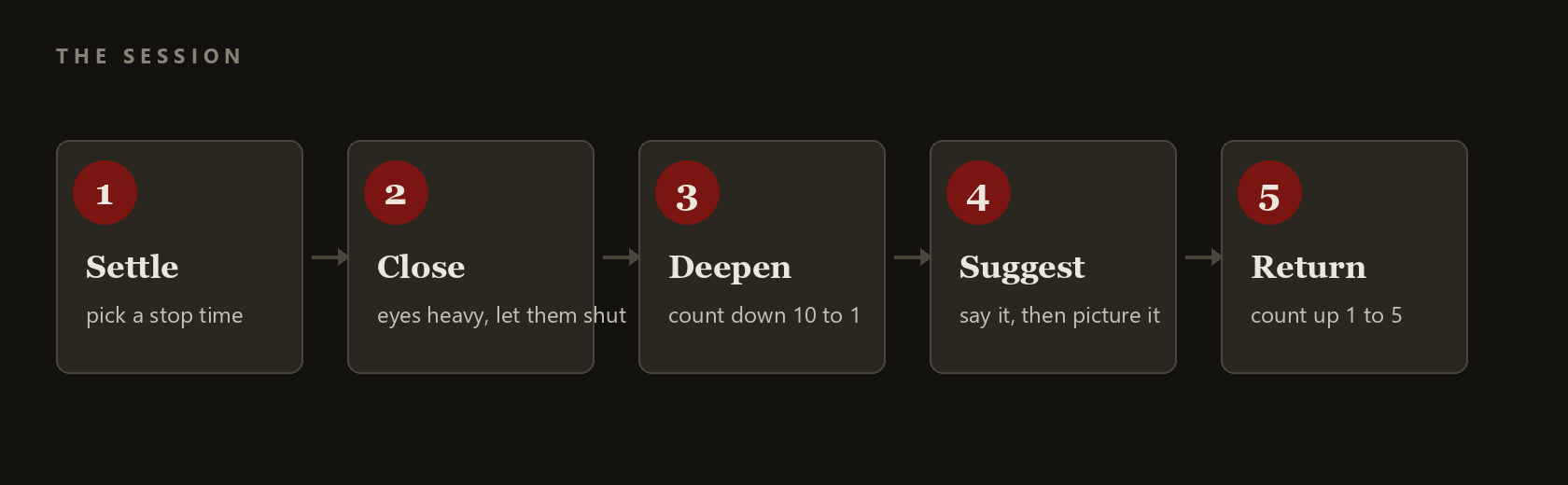
- Sit or lie somewhere no one will interrupt you for fifteen to twenty minutes. Once a day is the dose. Tell yourself when you will stop: “I’ll open my eyes in fifteen minutes.” Your mind keeps time better than you would guess.
- Pick a spot on the wall just above eye level and stare at it until your eyelids feel heavy, then let them close. If staring feels silly, tense and release each muscle group from your feet to your face instead. Both work.
- Go deeper by counting down from ten, one number on each exhale. If it helps, picture a stairway going down and take one step per number. A little heavier, a little quieter, each time. This is the part people mean when they say “going under,” and it gets dramatically easier with practice.
- Say your suggestion slowly, in your head, a few times. Then do the part that carries the weight: picture it, first person, through your own eyes. Do not just think “I stay calm.” See the scene from inside it, staying calm.
- Count up from one to five and open your eyes. If you feel groggy, sit for a minute. That is the whole thing.
The two rehearsals worth doing for an ex
The first is the contact rehearsal, because contact is coming. A text after a fight with their new partner. A call on a bad night. In your session, play it in first person with real detail: the phone buzzes, their name is on the screen, your chest tightens. Then watch yourself read it, breathe out, put the phone face down, and feel finished. You are pre-loading a response for the exact moment your willpower will be at its worst. That is what rehearsal is for.
The second is refiling. Your brain will replay the relationship’s highlights as proof the story is not over. The corrective suggestion puts the memory where it belongs: “I remember it clearly, and I remember how it ended.”
What not to do
Three things backfire or do not work.
Do not use this state to figure out what they “really” felt. Under suggestion the mind produces vivid, confident, wrong answers to exactly that kind of question. Hypnosis reliably raises confidence in a memory without making it more accurate, which is why most US states bar hypnotically refreshed testimony from witnesses. Their motives are unknowable. What they did is the data.
Do not turn sessions into contact. If your quiet time becomes imaginary conversations with them, or rehearsals of them coming back, that is the opposite of recovery. You are meditating on the obsession. Every suggestion should point away from them or it is fuel.
And do not start on the worst day. If you cannot sleep, eat, or focus, wait. This needs enough calm to concentrate, and a bad first try will convince you the whole thing is fake.
What it feels like and how long it takes
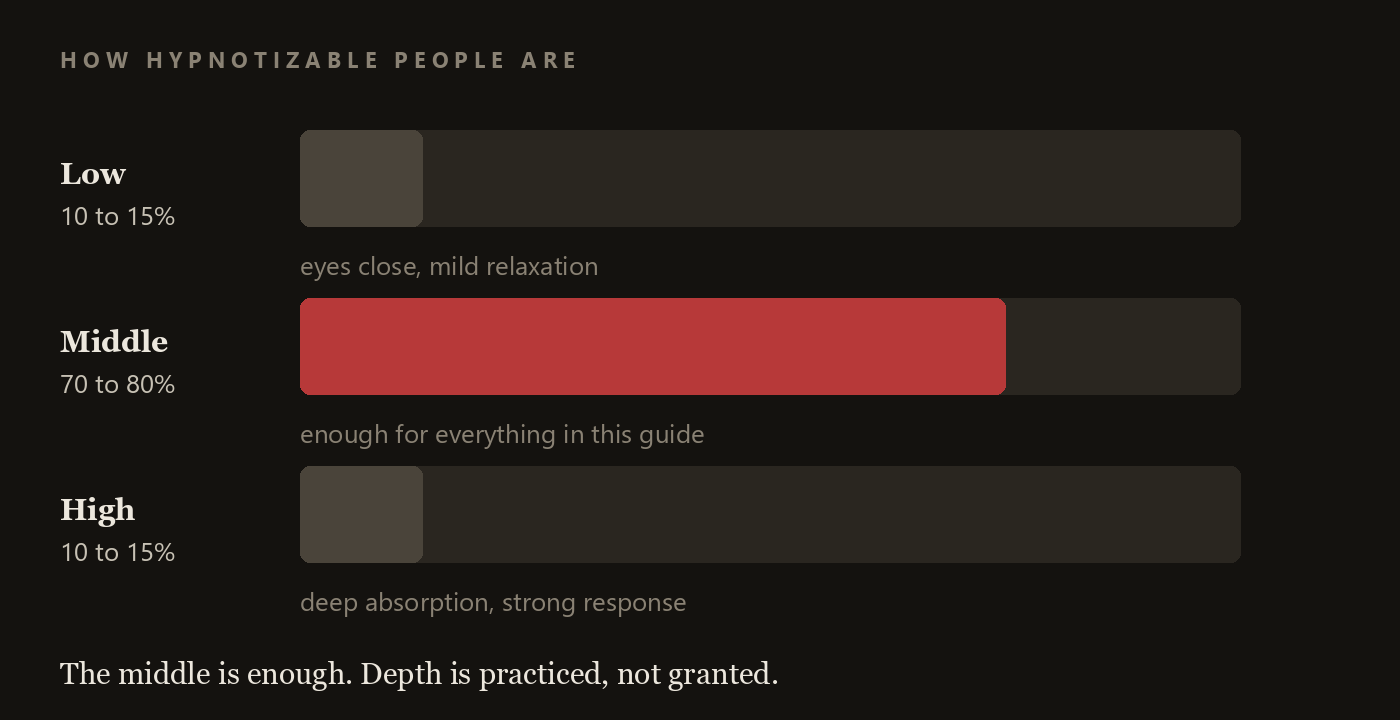
First sessions feel like sitting quietly with your eyes closed. That is normal, not failure. Roughly 10 to 15 percent of people are highly hypnotizable, 70 to 80 percent land in the middle, and 10 to 15 percent are low; the middle is plenty for this.
 Depth builds with repetition. The meta-analysis found self-hypnosis works best as a skill you practice yourself; the studies that showed no effect were mostly the ones where people just listened to a recording. The largest dataset we have on app-delivered self-hypnosis (84,395 users, nearly 283,000 sessions) found self-rated stress dropped in each of the first ten sessions.
The sign it is doing anything: the rehearsed scene stops feeling silly, or the next real reminder lands softer than the last one. Give it a few weeks of daily sessions before judging.
The boring truth
Hypnosis handles the craving layer. The cure is still the unglamorous list: no contact, their accounts blocked or muted, time, and people who pick up when the wave hits at midnight. The research on this is blunt, too: in one study of recently separated adults, more in-person contact with an ex predicted more distress two months later, at least for people without kids. Use the sessions to make the boring list easier to hold.
If weeks go by and you are still not functioning, or the thoughts go dark, a self-directed technique has hit its ceiling. Bring in a therapist.