The Pattern
Why documentation fails
Most people who experience abuse in an institution eventually write something down. The problem is not that they fail to document. The problem is that they document in ways that are useless when the moment comes.
A journal entry that says “Pastor was manipulative again today” is a feeling, not evidence. A note that says “On March 14, during the 9 AM staff meeting, Pastor X told the group that anyone who questioned the building fund would be ‘spiritually covering themselves in disobedience.’ Present: J. Martinez, K. Lee, T. Washington” is evidence. The difference is the entire case.
What to write
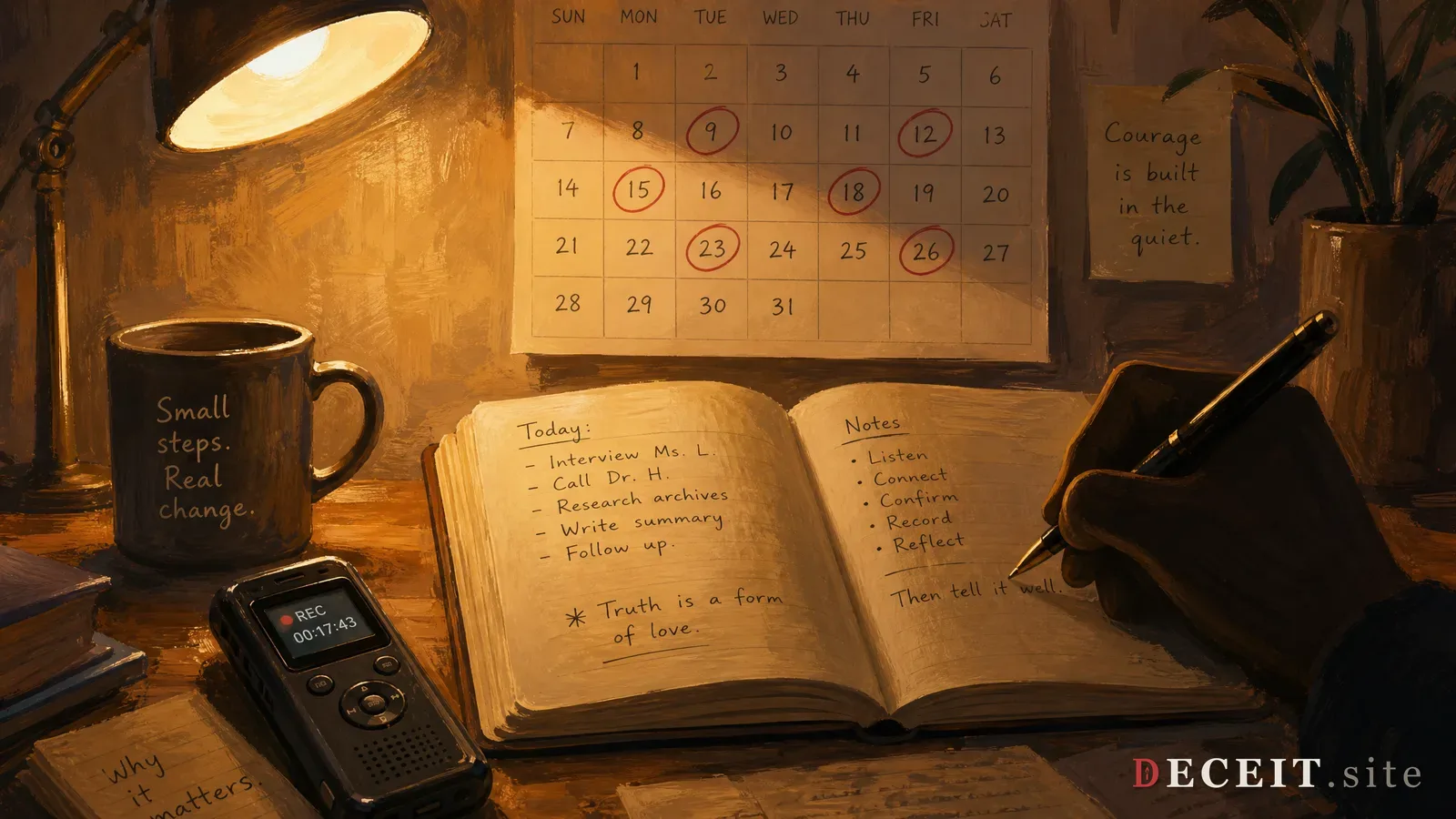
Every entry needs five things:
Date and time. Not “last week.” March 14, 2026, approximately 9:15 AM.
Location. The staff conference room. The Tuesday Bible study. The parking lot after the board meeting.
Who was present. Names. Not “several people.” J. Martinez, K. Lee, T. Washington.
What was said or done. As close to verbatim as you can manage. Quotation marks for direct speech. If you cannot remember the exact words, write “to the effect of” and paraphrase.
What you observed, not what you concluded. “He raised his voice and pointed at K. Lee” is observation. “He was intimidating K. Lee” is conclusion. Write the observation. Let the reader draw the conclusion.
When to write
The same day. Every time. No exceptions.
Contemporaneous notes carry legal weight that reconstructed notes do not. A court, a regulator, a denominational review board, and an HR department all treat a note made the same day differently from a note made three months later when the person decided to complain. The same-day note is evidence. The three-months-later note is a statement.
If you cannot write a full entry, write a timestamped one-liner on your phone. “3/14 9:15 staff mtg / pastor re: building fund disobedience comment / J, K, T present.” Expand it that evening. The timestamp is the anchor.
Where to store it
Not on the institution’s devices. Not in the church office. Not on the company server. Not in a shared email account.
Store the record in at least two of:
- A personal email account (send yourself the entry as an email; the server timestamp is independent verification)
- A cloud drive under your own account (Google Drive, iCloud, Dropbox)
- A physical notebook kept at home or at a trusted person’s house
- A text message thread with a trusted person (the recipient’s phone is a second copy you do not control)
The institution must not be able to access, alter, or delete the record. If they can, it is a draft they will destroy.
The pattern threshold
A single incident is an anecdote. The institution will call it a misunderstanding, an outlier, a bad day.
Three incidents with dates, witnesses, and consistent behavior is a pattern. A pattern is not dismissible. It is the difference between “that is not like him” and “this has happened nine times over four months with overlapping witnesses.”
You do not need to wait for three incidents to start documenting. You start with the first one. But you should understand that the institution’s first response to a single complaint will be to minimize it. The pattern is what makes minimization impossible.
Mistakes that destroy evidence
- Editing old entries. If you go back and change a note, the entire record becomes contestable. Add new entries; never alter old ones.
- Interpretation instead of observation. “He was gaslighting me” is a conclusion. “He told me the conversation I remembered did not happen, in front of two witnesses who later confirmed it did” is evidence.
- Storing only on institutional devices. The company laptop, the church shared drive, the work phone. These are not yours. They will be wiped.
- Waiting until you are ready to complain. By then, the details have faded, the witnesses have scattered, and the institution has had time to unify its story. Document now. Decide later.
- Sharing the record with the institution before you act. The moment they know the record exists, they will attempt to discredit it. Keep it private until the moment you file.
What documentation makes possible
A dated, factual, independently stored record is the foundation for every action that follows. It is what you hand to:
- An attorney (who will tell you whether you have a case)
- A regulator (who will tell you whether they have jurisdiction)
- A denominational body (who will tell you whether they will investigate)
- A journalist (who will tell you whether they can corroborate)
- A board of directors (who will tell you whether they will act)
Without the record, all of these conversations start with “it is your word against theirs.” With the record, they start with “here is what happened, here is when, here is who saw it.” That is the difference between a complaint and a case.
Next steps
- Challenging Church Leadership: The Mechanics: the specific mechanisms for faith organizations.
- What Happens After You Speak Up: the retaliation sequence, predicted and prepared for.
- The People Who Spoke Up and Won: five cases where documentation made the difference.