Self-deceit loop
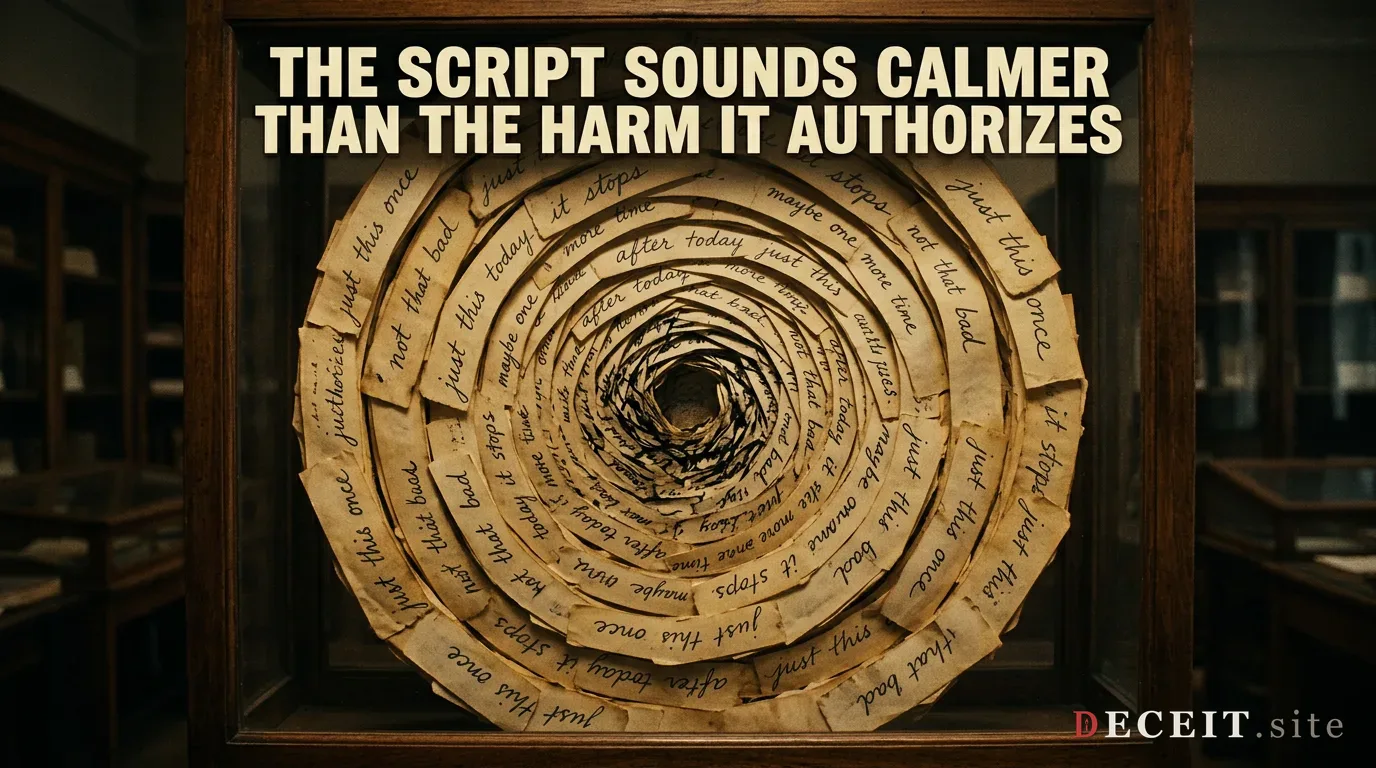
The permission story arrives calmer than the harm it is about to authorize.
Also known as Rationalization / cognitive dissonance
The internal cycle in which a person edits their own memory and judgment in real time to authorize a behavior they would otherwise refuse, then rewrites the event afterward so the authorization stays invisible. The loop has a script. Pressure builds. A permission story appears, calm and reasonable: just this once, it is not that bad, after today it stops. The act lands. The story mutates into shame, inevitability, or forgetting. Recognition arrives late, after the same script has run enough times to become visible from the outside. The power of the loop is that the person inside it is not lying to anyone else. They are genuinely convinced, in the moment, by the permission story. The story sounds calmer than the harm it authorizes. People remember the feeling of inevitability more strongly than the exact words that produced it. The loop is not a failure of intelligence. It is a failure of timing: the recognition arrives after the act, every time, because the script is designed to disarm the recognition until it is too late to matter.

Truth-adjacency
Truth-independent: the pattern works regardless of whether the claim is true
Where it shows up
Relationships and groups
How it works
What to watch for
The phrases and tells that mark this pattern in the wild:
a recurring behavior preceded each time by a calm, reasonable justificationthe justification changing shape after the act: from permission to shame to forgettingmemory of the event being edited in real time while it happensrecognition arriving only after the pattern has repeated enough times to be visiblethe person remembering the feeling of inevitability more clearly than the words that produced itHow to recognize it
The self-deceit loop becomes visible when the same behavior recurs, each time escorted in by a calm, reasonable justification that mutates after the act. The tell is the repetition with variation: the permission story is nearly identical each time, but it is experienced as new. Watch for the timing of recognition. If insight consistently arrives after the act rather than before it, the recognition is being disarmed by design. Also watch for the edit. If the memory of the event softens, blurs, or reorganizes soon after it happens, the loop is doing its maintenance work.
The Deceit question
- Is this justification new, or is it a repeat? If the words closely match a previous cycle, it is a script, not a reason.
- When does the recognition arrive? If it consistently lands after the act, the loop is disarming it on schedule.
- Does the memory of the event stay stable, or does it soften soon after? Real-time editing is the loop’s signature.
What it looks like when you’re wrong about it
You call “self-deceit loop” on a person who makes a genuinely considered decision with stable reasons that do not mutate after the fact. People rationalize sometimes. That is ordinary. The pattern requires a recurring behavior with a recurring permission story that is edited in real time and rewritten afterward. If the reasoning is consistent before and after, and revisable in light of new evidence, you are looking at judgment, not a loop. Do not pathologize a decision you simply disagree with.
Spot the pattern
One of these two real scenarios is Self-deceit loop. The other is a different pattern entirely. Which one is which?
The tell
A person who makes a considered decision, can articulate stable reasons for it, and whose reasons do not mutate after the fact is not in a self-deceit loop. The pattern requires the real-time editing of memory and the post-hoc rewriting of the justification. If the reasoning is consistent before and after the act, and the person can revise it in light of new evidence, you are looking at ordinary judgment, however imperfect.
What it feels like from the inside
- Like the decision was already made before you arrived at it.
- Like waking up inside a choice you do not remember making, holding a justification you do not remember forming.
How it starts
Pressure builds and the mind reaches for relief. A permission story arrives, already formed, calm and reasonable. It does not feel like a decision. It feels like a fact.
How it progresses
- Pressure builds and memory begins being edited in real time.
- A permission story appears: just this once, not that bad, after today it stops.
- The act lands and the story mutates into shame, inevitability, or forgetting.
- Recognition arrives late, after the same script has run enough times to become visible.
- Recovery begins when the story is caught before it earns the act, rather than after.
Common signs
- A recurring behavior, each time preceded by a calm, reasonable justification.
- The justification changing shape after the act.
- Memory of the event being edited while it happens.
- Recognition arriving only after repetition makes the pattern visible.
Why it's hard to leave
The script is designed to disarm the recognition until it is too late. In the moment, the permission story feels like insight, not rationalization. The shame that follows makes honest review painful, so the review is avoided, which preserves the script for the next cycle. The loop is self-protecting: the part of the mind that could catch it is the part the story is aimed at.
Do this now
- Write the permission story down when it appears. Externalizing it breaks the real-time edit.
- Compare this justification to the last one. If the words are nearly identical, it is a script, not a reason.
- Catch the story before it earns the act. Recognition that arrives after the fact changes nothing; recognition that arrives before changes everything.
- Bring the pattern to someone outside it. The shape is visible from the second person long before it is visible from the first.
What people realize later
Later, people realize the permission story was never a reason. It was a ritual. The words were nearly identical every time, and the feeling of inevitability they produced was the mechanism, not the conclusion. The loop did not survive because the behavior was irresistible. It survived because the story arrived first.
Recognized this in a relationship?
Misuse Guardrails
How this pattern gets misused
Someone uses the concept of the self-deceit loop to dismiss another person's sincere account of their own motivations, insisting that everyone is always rationalizing. Not every calm justification is a permission script. The pattern requires a recurring behavior with a recurring justification that mutates after the act. Calling every act of self-justification a loop flattens the term and pathologizes ordinary reasoning.
What it looks like when you're wrong about it
A person who makes a considered decision, can articulate stable reasons for it, and whose reasons do not mutate after the fact is not in a self-deceit loop. The pattern requires the real-time editing of memory and the post-hoc rewriting of the justification. If the reasoning is consistent before and after the act, and the person can revise it in light of new evidence, you are looking at ordinary judgment, however imperfect.
Not sure? Describe the situation to someone outside it. If they do not see the pattern, pause before you name it.
Related Patterns
Reality testing through absurd claims
You laughed. You did not believe it. You laughed because not laughing would have made you the only one not laughing. The laugh was the compliance. The claim was never the point.
Minimizing
It happened. They agreed it happened. Then they shrank it until your reaction looked excessive.
Gaslighting
You apologized for things you did not do. You did not notice the moment your memory became less trustworthy than theirs. That moment was the goal. That moment was the whole campaign.
Learned helplessness
The door was unlocked. You had stopped trying it so many times that you no longer looked.
Intermittent reinforcement
You stayed for the good moments. You did not notice that the good moments were on a schedule you could not predict, and that the unpredictability was the leash, not the cruelty.
The name is designed to spread. The hook is designed to stick. If you recognized something, share the name.
Seen a real example of self-deceit loop? Suggest it for the Register →