In 1389 a bishop wrote to the pope about a cloth.
Pierre d’Arcis had a burial shroud on display in his diocese at Lirey. Pilgrims were paying to see it. He told Clement VII that the cloth was a painting, that it had been “cunningly painted,” and that the artist who made it had confessed. He named the fraud, he named the method, and he sent it up the chain.
Six hundred years later, in 1988, three laboratories at Oxford, Zurich and Arizona independently radiocarbon dated the cloth. They put it between 1260 and 1390. The bishop’s letter falls inside that window.
The Shroud of Turin is still on display. It is still venerated. Millions have seen it since the labs published.
That is the entire pattern in miniature. The fraud. The exposure. The consequence that does not stick.
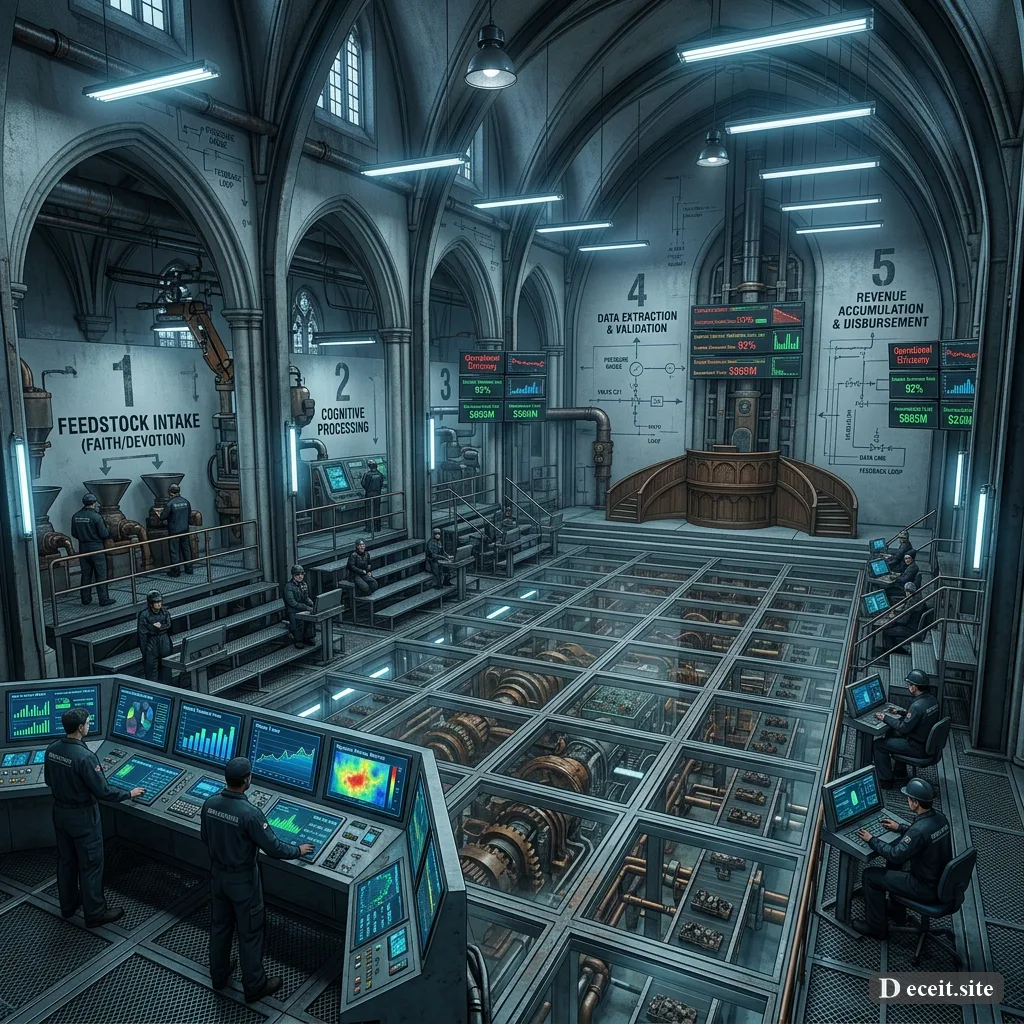
We documented 32 cases of modern religious fraud and found a five-part architecture underneath all of them. Different theologies, one machine. This is the same machine with the clock run back. The 32 cases cover about forty years. The architecture has been running for two thousand.
What the machine needs
Part one of that architecture is a supernatural claim that cannot be independently verified. That is the load-bearing element. Everything else in the structure sits on it.
The problem is that unverifiable claims are unstable. People eventually ask for the receipt. And when a claim is two centuries old and the witnesses are dead and nobody kept a record, there is only one way to produce a receipt.
You make one.
This is not a scandal at the edge of the tradition. It is a manufacturing process that ran continuously, in every century, in every idiom that century found persuasive.
The ledger
The Testimonium Flavianum. The Jewish historian Josephus wrote his Antiquities around the year 93. The copies we have contain a paragraph calling Jesus more than a man, naming him the Christ, and reporting that he rose on the third day. No practising Jew outside the movement wrote that. The proof is not stylistic taste, it is a paper trail. Origen, writing around 248, says plainly that Josephus did not accept Jesus as the Messiah. That is impossible if Origen’s copy read like ours. The first person to quote the passage in its current form is Eusebius, around 324. Somebody edited a historian to say the opposite of what he said.
The letters of Jesus and Abgar. A correspondence between Jesus and a king of Edessa, which Eusebius said he translated out of the Edessan archives. A third-century fabrication. Listed as apocryphal by the sixth century. No scholar defends it.
The Acts of Pilate. Official Roman records of the trial. Rome kept no such archive. Justin Martyr told his readers around 150 that they could consult “the Acts of Pilate,” which was a rhetorical dare rather than a citation, because no such text is quoted by anyone for another two hundred years. Then one appears. It reads exactly like what a fourth-century Christian would want a Roman prefect to have written down.
The Letter of Lentulus. A first-century Roman official’s physical description of Jesus, sent to the Senate. It describes him in medieval European iconography, in medieval Latin, and no Roman officer of that name held the post the letter claims for him. It circulated for centuries as a portrait from life.
The Nazareth Inscription. A marble slab carrying an imperial edict against tomb robbery, published in 1930 and read for decades as Rome reacting to reports of an empty tomb. In 2020 an isotope study traced the marble to a quarry on Kos. The likeliest subject is a local Greek grave disturbance. Not a forgery. A false connection, which is cheaper to make and harder to dislodge.
Secret Mark. Morton Smith announced in 1958 that he had found a letter of Clement quoting a longer, suppressed version of Mark’s gospel. Many specialists judge it Smith’s own hoax. The manuscript has since become inaccessible and cannot be tested, which leaves the question permanently open. That is its own kind of result.
The James Ossuary. A burial box surfaced on the antiquities market in 2002, inscribed “James, son of Joseph, brother of Jesus.” Israel’s antiquities authority declared part of the inscription forged in 2003. The owner was tried and acquitted in 2012. The judge went out of his way to say the acquittal was for lack of proof and was not a finding of authenticity. The distinction did not survive the headlines.
The Gospel of Jesus’ Wife. Announced at Harvard in 2012, a Coptic fragment in which Jesus refers to “my wife.” It reproduced a typographical error from a Gospel of Thomas PDF that had been posted online in 2002. Journalists traced the provenance to a modern owner in Florida. The scholar who published it conceded in 2016.
Nineteen centuries. The same product.
The forgery is inside the book
The version most people have not been told is that the canon is not a stable text that forgers later attacked from outside. The canon contains forgeries.
Thirteen letters carry Paul’s name. Critical scholars regard seven as certainly his. The letters to Timothy and Titus are widely judged to be written by later authors wearing his name, and 2 Peter is near-universally regarded as pseudonymous. These are not disputed appendices. They are scripture, and they claim an author they do not have.
Then the insertions. The clearest statement of the Trinity anywhere in the Bible sits at 1 John 5:7 in the King James Version. It appears in no Greek manuscript before the fourteenth century. It was a Latin marginal gloss that walked into the text, got pressed into Erasmus’s printed Greek edition under commercial pressure, and travelled from there into English. The last twelve verses of Mark, which contain that gospel’s resurrection appearances, are missing from the oldest complete manuscripts. So is the story of the woman taken in adultery.
None of this is a fringe claim. It is printed in the footnotes of most study Bibles. It is simply not read.
Why it never stops
Four mechanisms, and they compound.
Writing under a revered name was normal. Ancient Jewish, Greek and Christian literature is full of it. Ancient readers did object when they caught it, so this was never cost-free, but the practice carried nothing like the modern stigma. A text needed an apostle’s name to be taken seriously. So texts acquired one.
Demand is permanent and supply is fixed. No genuinely new first-century evidence has surfaced in a very long time and there is no reason to expect any. A relic can be manufactured. A document can be written. A fact cannot. When demand exceeds supply by that margin, the gap gets filled with whatever can be produced.
Every era forges in its own idiom. Late antiquity made letters and secret gospels, because that is what authority looked like then. The medieval church made relics, because physical contact with holiness was the currency. The nineteenth century made Roman official documents, in the age that trusted archives. The twenty-first century makes papyrus fragments and runs them through peer review, because that is where credibility now lives. The forger is always fluent in the present.
The money and the status are real. An authenticated artifact is worth a fortune on the antiquities market and the announcement is worth a career. Both modern cases above arrived through unprovenanced private hands, which is precisely the route that defeats verification.
Underneath all four sits the thing that generates them. The record is thin, and it is thin in exactly the places where the stakes are highest. Nobody forged evidence that a Galilean preacher was baptised, because nothing depends on it. The forgery clusters around the resurrection, the trial, and the body.
Fraud is a reliable indicator of where the evidence ran out. It is a map of the load-bearing claims.
The fraud that runs the other way
If you have left the faith, the most useful thing to know is that a large share of the popular material on your side is also fabricated, and repeating it will cost you the argument.
The claim that Jesus is a recycled Horus, or Mithras, or Krishna, born of a virgin on 25 December, with twelve disciples, crucified and risen after three days, traces mainly to Kersey Graves and The World’s Sixteen Crucified Saviors of 1875, and more recently to the Zeitgeist film. The specifics are not in the Egyptian or Persian sources. Horus was not born of a virgin on 25 December. He had no twelve disciples. He was not crucified. Graves invented, and the internet repeated, until it sounded like something everybody already knew.
This is the same machine. Unverifiable claim, authority who benefits, community that treats questioning as betrayal. It does not require a church.
The cost is concrete. The genuinely strong point about this record is that the first-century evidence is nearly silent and what survives has been demonstrably tampered with. That point gets thrown out along with the Horus material, by people who are right to throw out the Horus material.
What this is not
This is not an argument against faith. It is not a claim that the tradition is a fraud. It is not contempt for anyone who believes.
It is a record of what gets manufactured when a claim matters more than the evidence for it can bear, and an observation that the manufacturing has never stopped. Most of the people who made these documents were not cynics. Pious forgery was largely done by believers, for believers, to supply what they were certain was true and could not otherwise prove.
That is the uncomfortable part. The forger and the faithful are usually the same person, and the forgery is usually an act of devotion.
Pierre d’Arcis got his letter to the pope in 1389. The labs confirmed him in 1988. The cloth is still on display.
Exposure was never the mechanism that stops this. Naming it is just where you start.