Everyone hates AI. The rest of the world disagrees.
Evidence-first pattern recognition. Sourced to reputable reporting.

The Pattern
Half of American adults have used an AI chatbot. Four in ten Americans say AI will hurt society over the next twenty years. The same people, in the same surveys.
And there is a part of this story the American press keeps leaving out. The rest of the world disagrees.
The hatred is local
Pew surveyed 25 countries. Between 2024 and 2025, the global share saying AI’s benefits outweigh its drawbacks rose from 55% to 59%. In China, 83% view the technology positively. In Indonesia, 80%. In Thailand, 77%. The pattern is consistent, and uncomfortable. AI optimism runs inversely with GDP. The richest countries on earth, the United States, Switzerland, the Netherlands, Norway, are the most hostile. Developing countries look at the same technology and see access. Healthcare. Education. Services they were never offered.
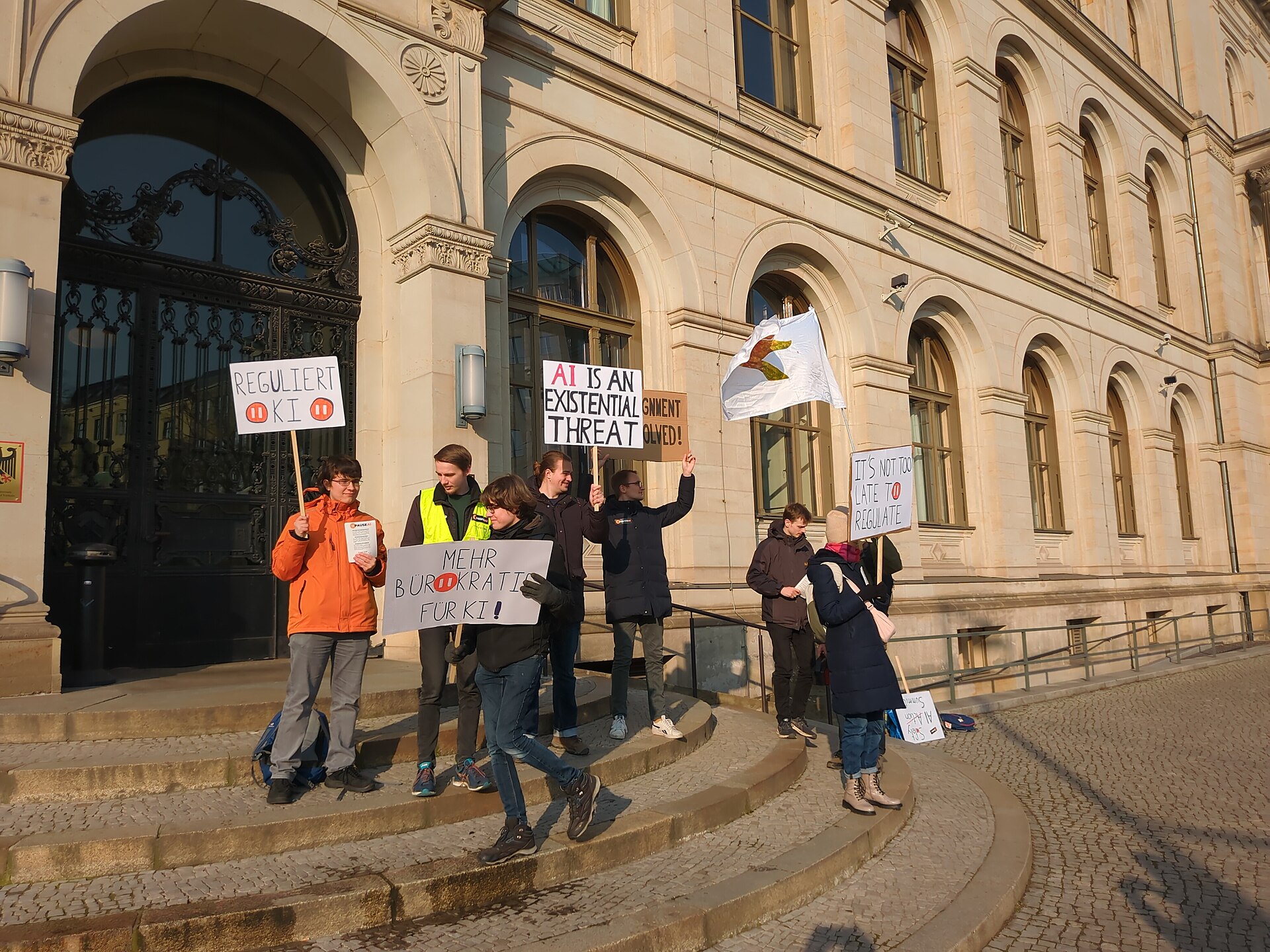
In America, 40% expect AI to harm society while 24% use chatbots every day. Eric Schmidt gets booed at commencement speeches. Reuters/Ipsos polling finds 57% of Americans would oppose a data center in their own neighborhood, two-thirds of Democrats and half of Republicans among them, while only 14% would welcome one. This is not the universal human reaction to a new technology. It is a rich-country condition, and specifically an American one. It deserves a diagnosis, not a shrug.
Why us, specifically
The American backlash has five documented causes. Most of them are rational.
1. The industry told us to be afraid. Anthropic’s CEO told Axios in May 2025 that AI could wipe out half of entry-level white-collar jobs and push unemployment to 20% within five years. He later walked back those remarks. Much of the fear the industry now resents, the industry made for fundraising.
2. We got the technology without the consent. AI search with no opt-out. AI bolted onto products that worked fine. Workers told to adopt tools to satisfy financial markets. People resent what they cannot refuse.
3. The bill is visible and local. Two-thirds of data centers built since 2022 sit in water-stressed regions. Texas data centers alone drew 49 billion gallons of water in 2025, on a trajectory toward 399 billion by 2030. When the cost lands on your zip code, the abstraction ends.
4. Tech had already burned the trust bank. In 2015, 71% of Americans said tech companies help the country. That goodwill was gone before ChatGPT launched. AI arrived on top of a deficit, not into a neutral public.
5. AI is welded to the least popular people in America. The technology is perceived, with reason, as a wealth-concentration machine promoted by oligarchs. Some of the anger is class politics wearing a tech costume.
None of this is bigotry. None of it is a failure of reason. A pro-AI position that opens by disparaging the opposition has already conceded the argument. Even the insult is misread. The original Luddites were not anti-machine. They were a labor movement resisting machines being used against workers, against wages, skills, and dignity. Their honest heirs today object to deployment politics, not to the machines.
What’s real
The grievances that hold up, and what to do about them.
Jobs. Real, uneven, not apocalyptic. Stanford economist Erik Brynjolfsson and colleagues found employment falls of 6 to 16% in AI-exposed occupations among workers aged 22 to 25, but the unemployment rate for those workers stayed flat. Demand for entry-level AI skills has nearly tripled. Goldman Sachs’ worst case is 6 to 7% of the workforce displaced, not eliminated from the economy. Count every loss honestly. One analysis tallied roughly 76,000 position eliminations attributed to AI in 2025. The honest conclusion is still transition, not extinction. The answer is rebuilding entry ramps and transition support, not denial.
Creators. The courts have already drawn the line. Training on lawfully acquired books is fair use. Keeping millions of pirated books is not. Anthropic paid $1.5 billion to settle. Licensing markets work. Pay for inputs, keep building.
Environment. Global data centers used 448 TWh in 2025, more than all but about ten countries, and consumed 1.2 trillion gallons of water, per UN University’s June 2026 assessment. That is real. It is also solvable. Siting rules. Disclosure. Ratepayer protection. Efficiency gains that are already landing. Per-query consumption, by the most careful estimates, runs from a few spoonfuls to one bottle of water per chat session. The problem is aggregate, and aggregates are what policy is for.
Bias. The EEOC has already settled a discrimination suit over an AI hiring tool. New York City now requires bias audits for hiring algorithms. The fix is audits, human review, and liability on deployers. That is a deployment argument, not an anti-AI argument.
Grant all of it. Every one of these is a reason to govern the technology better. None of them is a reason to abolish it.
What’s manufactured
There is a dishonest part of the backlash too. And it has a budget.
The Washington Post reported in April 2026 that AI-doom organizations are paying content creators to push existential-risk messaging, recruiting influencers with tens of millions of subscribers. One viral doom campaign lists a budget of $100,000 a month on its own application form. A $140 million super PAC funded by tech executives has paid TikTok influencers to fear-monger from the other direction. Politicians on both flanks are farming the same anger for votes. A 50% public-ownership bill from the left. Challenger bills from the right. A “Humans First” movement staging protests at 140 data centers in 42 states. Fear of AI is a content category with budgets and KPIs.
The misinformation shows up in specifics too. The viral claim that a single ChatGPT query uses 17 gallons of water is false. Google’s counter-claim of five drops is also not the full picture. CBS found the competing estimates differ by hundreds of times because they measure different things. In their words, complex findings become over-simplified slogans. Snopes debunked 25 “AI slop” rumors in 2025 alone.
And note the symmetry on the other side. The FTC’s Operation AI Comply has chased company after company for “AI-washing”, including a firm that sold “Active Listening” ads, marketed as AI that listens to your conversations through your phone. It never listened to anything. It was resold email lists.
Two rival deception economies are fighting over your opinion of this technology. One sells apocalypse. One sells magic. Neither is describing the machine.
The panic is a rerun
This is not the first time. It is barely even an interesting time.
Psychologist Amy Orben documents the Sisyphean cycle of technology panics. Novels overstimulating imaginations. Radio weakening civic life. Comic books causing delinquency. Television rotting minds. Video games breeding violence. Smartphones destroying attention. Swedish preachers called the telephone the instrument of the devil. Victorian doctors diagnosed “bicycle face” to police women riding unchaperoned. Every one of these panics included a claim of exceptionalism, that this time is different. The claim was itself part of the pattern, every time.
“Television rots your brain” became “ChatGPT destroys critical thinking.” The object is new. The anxiety is the oldest one there is. A tool arrived faster than society agreed on the rules. The AGI apocalypse layer of the current panic, superintelligence, machine sentience, the end of all work, rests on projection rather than observation. No credible body of evidence places autonomous superintelligence in the near term, and forecasting itself has a poor track record in both directions. Call it what it is. A moral panic wrapped around a core of legitimate grievance. Keep the core. Discard the wrap.
What the machine actually does
Strip away both marketing departments and look at the deployments with measurement attached.
- Work. In the largest field study, AI assistance raised customer-support productivity 14 to 15% on average, and 34% for novice and low-skilled workers. The gains flowed to the bottom of the skill distribution. AI is a leveler, not a replacement. IKEA’s internal assistant reskilled workers instead of cutting them.
- Medicine. AI-assisted chest CT reading cut interpretation time 22% in a randomized trial. Ambient scribes cut physician documentation nearly 30%.
- Science. AlphaFold predicted the structures of ~200 million proteins, nearly every cataloged protein on earth, made free, and won the 2024 Nobel Prize in Chemistry. It is now in neglected-disease drug design and antibiotic-resistance research.
- Education. A Harvard RCT found students with a tailored AI tutor showed roughly double the learning gains of a traditional classroom, with higher engagement. Separate trials found the largest gains arrive when AI supports the least experienced instructors. The tool raises the floor. That is what equity looks like in software.
- Access. The AP profiled a dyslexic 14-year-old whose AI reader turned her grades around. Real-time transcription for deaf students. Object recognition for blind users. The people least quoted in the backlash are the ones the technology serves most directly.
- The users’ own verdict. Among Americans who actually use chatbots, positive self-reports outnumber negative ones about six to one on productivity and five to one on staying informed. The people closest to the machine like it, and they vote with their feet. Usage climbed from 33% of American adults in 2024 to 49% in a single year.
And the honest caveat, because credibility is the point. MIT’s NANDA lab found 95% of enterprise generative-AI pilots fail. The failures, its report stresses, are not because the models don’t work. Integration is done badly. The tool is more capable than the deployment. Fix the integration.
Who paid for this
One last fact. The one that reframes everything.
The National Academies’ own history concludes that AI’s growth “has depended largely on public investments.” DARPA funded the field from the 1960s through the 1990s. NSF funded ImageNet, the neural-network foundations, and the tutoring research behind Duolingo. The models were then trained on the accumulated knowledge and labor of the public. Public money built the science. Public content trained the machine. Private shareholders collected the returns. And billionaire wealth, propelled by the AI trade, just hit $18.3 trillion, according to Oxfam.
The fix is not to hate the machine. It is to own a piece of it. The Alaska Permanent Fund, created by a Republican governor, has paid every resident a dividend from oil wealth since 1980, and 81% of Alaskans say it improves their lives. Senators have drafted the AI version. A sovereign wealth fund that would pay every American roughly $1,000 a year. And remarkably, the CEOs of OpenAI and Anthropic themselves are now proposing the same structure. When the people whose companies would be taxed propose versions of the tax, the argument has moved from radical to pending. The public already paid for this technology. The only argument left is how much of it we own.
What pro-AI actually means
So here is the position, in full.
The technology is not the enemy. Here is what is. Fear sold as fundraising. Adoption without consent. Costs pushed onto neighborhoods. Dread invoiced from either direction. The American backlash is real, mostly rational at its base, and being farmed by everyone who can bill against it.
Pro-AI does not mean defending every decision made by every company. It means refusing to let two propaganda machines define the machine. It means demanding the technology be deployed well. Opt-outs. Licensing. Disclosure. Audits. A public stake. And that is exactly where the public and AI experts already converge. Pew found both groups want more control over how AI is used in their lives, and both doubt the current arrangements deliver it.
Nearly half the country has used this thing. One in four uses it every day. The rest of the world is optimistic and rising. The measured evidence says it levels skills, reads scans faster, folds proteins, and teaches children twice as well.
Hate is not a finding. It is a mood, with a budget. We have receipts.
Patterns in this piece
Rage bait
The post was not written to inform you. It was written to make you angry enough to share.
Engagement farming
The outrage was the crop. You were the field.
Inevitability framing
You adapted because you were told there was no alternative. 'No alternative' was the argument, not the evidence.
False balance
They gave both sides equal time. One side had the evidence. The other had a microphone.
Sources
- Pew Research, Americans and AI 2026
- Pew Research, How People Around the World View AI
- Stanford HAI, 2026 AI Index: Public Opinion
- Economics Observatory, Who trusts AI?
- Paul Krugman, Why Does Everyone Hate AI?
- Axios, Anthropic CEO warns of AI-driven job losses
- NPR, Anthropic to pay $1.5 billion settlement to authors
- PBS/AP, Energy, water use and pollution of AI rival most countries
- Washington Post, AI doom influencers
- Wired, Super PAC backed by OpenAI and Palantir paying TikTok influencers
- CBS News, How much water does AI really use?
- FTC, Operation AI Comply crackdown on deceptive AI claims
- Orben, The Sisyphean Cycle of Technology Panics
- Brynjolfsson, Li, Raymond, Generative AI at Work (NBER)
- Harvard Gazette, AI tutor doubles physics learning gains
- Drug Discovery Trends, 7 ways AlphaFold is used in life sciences
- National Academies, Funding a Revolution: Government Support for Computing Research
- Sanders Senate office, American AI Sovereign Wealth Fund Act
- FDI Intelligence, AI needs its own sovereign fund
- SSRN 5316265, AI-attributed position eliminations in 2025
- Goldman Sachs, How will AI affect the global workforce?
- NACE, Demand for AI skills in entry-level jobs nearly triples
- UN University (INWEH), Environmental cost of AI's energy use, carbon, water, and land footprints
- Image (surface wipe): Protest against the AI Action Summit, Berlin, February 2025, C.Suthorn, CC BY-SA 4.0, Wikimedia Commons
- Image (truth wipe): Radiologist viewing computed tomography, Bill Branson, National Cancer Institute, public domain, Wikimedia Commons
Related Deceit
The tool is good. The leak is not the plan.
Multiple sources (11)

How AI gets used to sell you things that do not exist
Multiple sources (6)

The Epstein client list does not exist, and that is why the theory will never die
Multiple sources (4)