
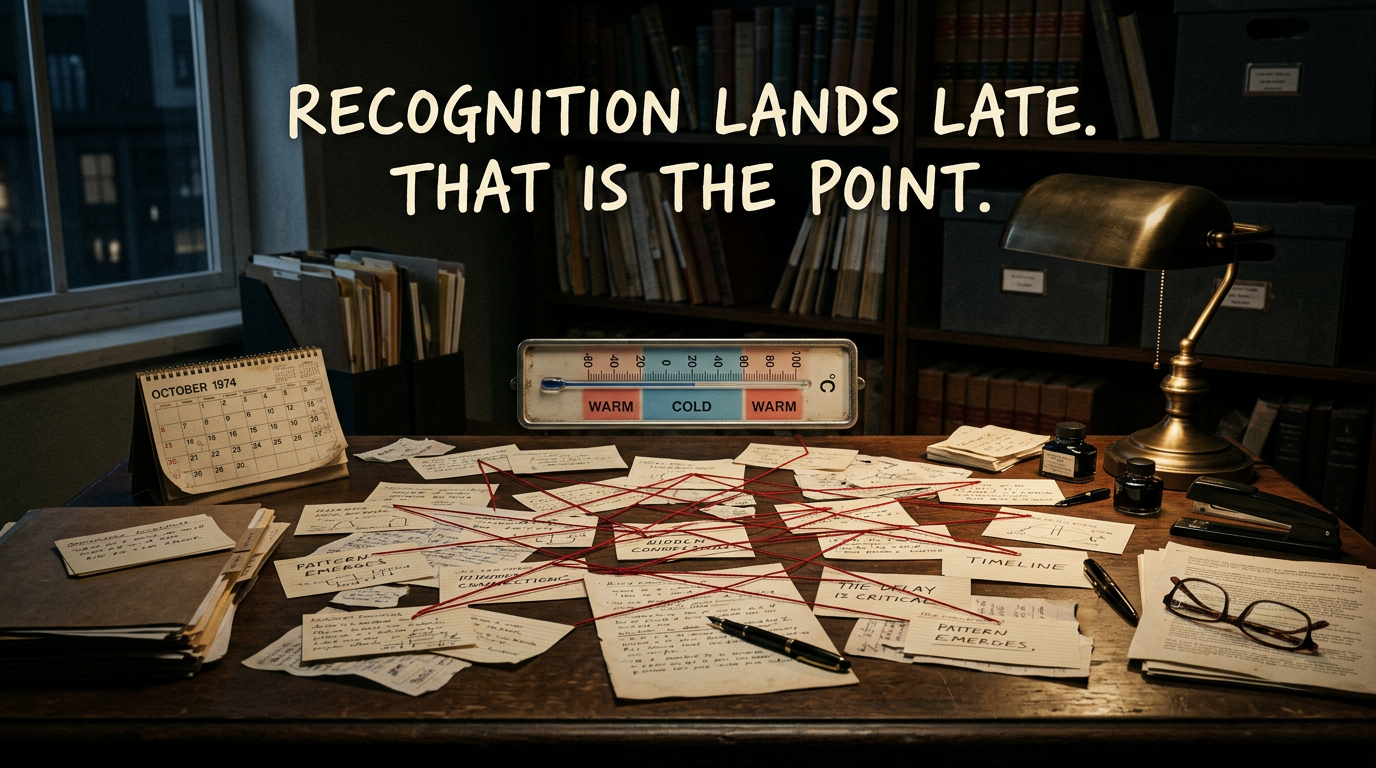
Recognition lands late, and that is the point.
Evidence-first pattern recognition. Sourced to reputable reporting.

This piece describes lived experience of coercive manipulation.
If this content may be triggering, skip to recovery resources →
The Pattern
Recognition rarely arrives dramatically. It lands after the body was already trying to tell the truth: after the notes, after the temperature changes, after the promised version finally stops outweighing the real one.
The warmth that kept the loop alive
It was warm, then cold, then warm again. The change in temperature became the whole atmosphere. A lot of people do not begin with a label. They begin with the feeling that the pace and tone keep shifting so fast they cannot stabilize their read of the relationship.
Sometimes the good version did come back. That was enough to keep the loop alive. The return becomes proof that the pattern is temporary, even when the cycle is stable.
The concern that made the world smaller
Restriction rarely introduces itself as restriction. A lot of isolation begins through warnings, soft pressure, or repeated framing that makes outside people and information feel unsafe to trust.
The notes that were not paranoia
The notes were not paranoia. They were compensation. When memory stops feeling enough, writing things down is not a breakdown. It is a survival strategy responding to an environment designed to make your own perception unreliable.
The future that carried more weight than the present
When promises do the holding work, current harm can start reading like a temporary bridge to the future instead of evidence about the actual structure. The future was carrying more weight than the present. That is not hope. That is future-faking doing its job.
Why leaving felt worse than staying
Entrapment often feels moral before it feels structural. By the time people can see the pattern, attachment, duty, fear, and hope are already entangled. That is why delay should not be mistaken for consent.
What changes when recognition finally sticks
The explanations that used to hold start losing their grip. The pattern becomes legible as a pattern, not a series of isolated incidents. The body’s earlier signals start making sense. New choices become possible because the old frame is no longer doing the holding work.
What changes is not the past. It is the ability to stop translating the pattern into something easier to carry.
Patterns in this piece
Gaslighting
You started checking your memory before you checked the behavior.
Intermittent reinforcement
The relief never lasted. It lasted just long enough.
Isolation through concern
The warning sounded protective. The effect was that you had less room.
Future-faking
The future stayed vivid. The follow-through stayed thin.
Love-bombing
It moved faster than trust usually moves. That was part of the point.
Crisis cycling
Every time the pattern was almost named, something else became too urgent to question.